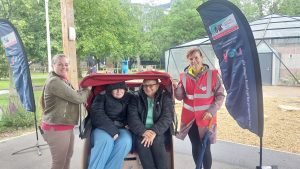
When services are under pressure, improvement is often associated with new funding. This project showed that having dedicated time for research can be valuable, helping social care identify unmet needs, connect existing assets and make evidence-informed decisions about where resources can have the greatest impact.
Funded through the Department of Health and Social Care’s Accelerating Reform Fund, the Your Break Your Way project led by Gina Mula, Portsmouth Carers Centre Development Officer, explored carers’ breaks and respite support in Portsmouth. More than 200 carers, alongside professionals from health, social care and the voluntary sector, shared their experiences through surveys, focus groups and interviews.
A key advantage was that Gina was already embedded within the carers service. Her established relationships, understanding of carers’ needs, barriers and knowledge of local support meant the project could move quickly from engagement to action. With support from the Health Determinants Research Collaboration (HDRC) Portsmouth, the research created protected time to gather evidence, strengthen community partnerships and explore opportunities that day-to-day delivery often leaves little time for.
The findings confirmed barriers around awareness, access, travel, communication and navigating support. They also highlighted that many carers were using their breaks to complete household tasks or attend appointments rather than support their own wellbeing. Nearly half of respondents reported having their own disability or long-term health condition.
Importantly, the project showed that many solutions already existed within the community. Using an asset-based approach, the service identified opportunities to expand the carers’ breaks offer through partnerships with organisations already delivering wellbeing, learning, leisure and community support. This helped increase choice for carers without requiring significant new investment.
The findings also highlighted opportunities to improve the carers’ breaks website and booking process. By connecting with existing digital and customer service teams within the council, the service was able to begin developing a more accessible and user-friendly experience without the need for significant additional investment.
Improvements to the website and booking system are now being developed in response to the findings, helping make information and access to breaks easier for carers. A refreshed online offer will be launched in the coming months.
Gina Mula, Portsmouth Carers Centre Development Officer, said:
“We’re really excited to support carers in exploring the fantastic range of activities and services available across Portsmouth. By working together with carers and community partners, we can help carers find new ways to look after their wellbeing while continuing in their caring role.”
The biggest benefit of embedded research is not only generating new ideas. It’s creating the evidence and connections needed to act on the ideas and assets that already exist.
While the findings themselves were not unexpected, the project created something that is often difficult to find in busy social care services: protected time to gather evidence, build partnerships and explore solutions. Having dedicated time for research helped document carers’ experiences, identify unmet needs and connect existing community assets to practical service improvements.
HDRC Portsmouth’s role was to support this work by helping connect the project to wider research opportunities, including Applied Research Collaboration (ARC) Wessex Research Champion funding and opportunities to share learning beyond Portsmouth.
Most recently, the project’s abstract has been accepted for presentation at the annual National Institute for Health and Care Research (NIHR) Social Care Conference in Bristol on 15-16 September, enabling the findings and learning to reach a wider audience.
For social care services facing increasing demand and limited resources, the message is simple: before creating something new, take time to understand what already exists. Embedded research can help turn local knowledge into evidence, and evidence into action.
HDRC Portsmouth supports services and community organisations to use evidence to better understand local needs. If you have an idea, challenge or service improvement project you’d like to explore, we’d love to hear from you.
Email hdrc@portsmouthcc.gov.uk to find out how we can help turn local knowledge into action.